“Our token spend went up 9x this quarter and the product didn’t get 9x better. Do we just move everything to a cheaper model?”
I get some version of this question every few weeks now. The volume is real, the panic is real, and the proposed fix is almost always wrong. Moving everything to a cheaper model is how you trade a cost problem for a quality problem, and the quality problem shows up in front of customers about two weeks later.
There is a better answer, and it isn’t clever. Send the boring work to a small model, keep the expensive model for the work that earns it, and check the cheap answer before you trust it. That last clause is where all the engineering lives.
Table of Contents
Open Table of Contents
It’s arithmetic, not magic
Small models are somewhere between 10 and 60 times cheaper per token than frontier models, depending on which pair you compare. That spread is the entire opportunity. If you can safely move the routine majority of your traffic down a tier, your blended cost collapses even though the hard requests still hit the expensive model.
Here is the shape of it. Illustrative bands per million tokens, and please check current list prices before you quote any of these to a CFO, because they move every few months:
| Tier | Typical models | Rough band per 1M tokens |
|---|---|---|
| Small | Claude Haiku, Gemini Flash, Nova Lite, small Llama or Mistral | $0.10 to $1 |
| Mid | Claude Sonnet, Gemini Pro, Nova Pro | $1 to $5 |
| Frontier | Claude Opus, GPT flagship, the reasoning models | $10 to $75 |
Now put a realistic traffic mix through it. Index everything to the frontier tier at 1.0, call mid 0.2, call small 0.067 (about fifteen times cheaper), and include the cost of retrying the requests that fail their quality check:
| Traffic | Share | Unit cost | Cost |
|---|---|---|---|
| Small tier | 75% | 0.067 | 0.050 |
| Mid tier | 20% | 0.2 | 0.040 |
| Frontier | 5% | 1.0 | 0.050 |
| Retries: 15% of small calls redone at mid | 11% | 0.2 | 0.023 |
| Retries: 10% of mid calls redone at frontier | 2% | 1.0 | 0.020 |
| Blended | 0.183 |
That’s an 82% reduction against sending everything to the frontier model, with the retry cost paid for honestly rather than hidden. Notice something in that table: the 5% of traffic that goes straight to frontier costs as much as the 75% that goes to the small tier. The frontier share is the number to watch, not the small-tier share.
Why the cheap tier is so much cheaper
You’re paying for compute, and several factors stack up.
The dominant one is parameter count. Cost tracks how many parameters have to fire to produce each token. A frontier model runs hundreds of billions to trillions; a small model runs a fraction of that. Fewer parameters means fewer operations per token, which means less accelerator time, which means a lower price. Roughly linear, and it swamps everything else on this list.
Then there’s distillation [8]. A large teacher model trains a small student to imitate its behaviour on a target distribution of tasks. The student keeps most of the everyday quality at a fraction of the size, and at inference time you pay for the student, not the teacher that produced it.
Small models also fit on fewer and cheaper accelerators, and they batch better. A provider can pack far more concurrent requests onto the same hardware, which spreads the fixed cost over more billable tokens. Mixture-of-experts architectures [9] push the same way from the other direction: only a subset of parameters activates per token, so effective compute stays low even when total parameter count is large.
Here’s the part that matters for your architecture:
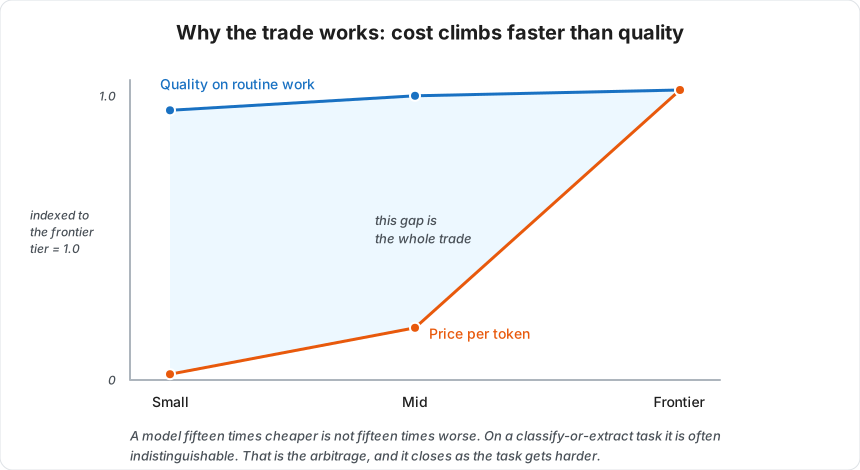
Capability does not scale linearly with price. A model that costs fifteen times less is not fifteen times worse. On “classify this ticket”, “pull these six fields out of this document”, or “summarise this paragraph”, the outputs are often indistinguishable in a blind comparison. The gap between the cost curve and the quality curve on easy work is the whole trade, and it narrows as the work gets harder. Your job is to figure out where, for your traffic, it closes.
What the pipeline looks like
None of this is provider-specific. Every major platform now gives you the same set of pieces: one API in front of many model families, a guardrail service, a batch endpoint at roughly half price, prompt caching, and per-request usage metering. AWS Bedrock, Azure AI Foundry, and Google Vertex AI all qualify, and so does an open-source gateway like LiteLLM or Portkey in front of direct provider APIs. Pick whichever your platform team already runs. What matters is that swapping the model on a request is a config change and not a new integration, because that’s the property routing depends on.
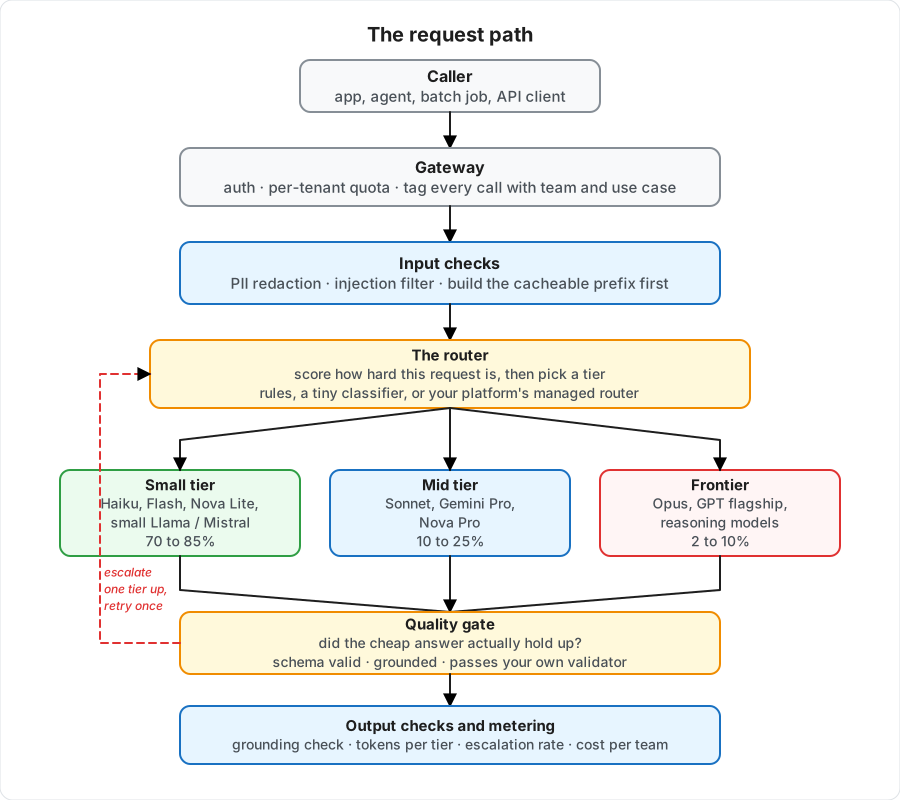
Six things are happening there, and only one of them is interesting.
The gateway authenticates the caller, enforces a per-tenant quota, and tags every single call with a team, a use case, and a cost centre. Do this on day one. Retrofitting attribution onto a year of untagged traffic is miserable, and without it you cannot tell whether your bill went up because usage grew or because someone shipped a prompt that tripled in size.
Input checks redact PII, screen for injection, and assemble the prompt with the static parts first so the cacheable prefix is as long as possible. Cache reads cost a fraction of fresh input tokens on every major platform [6] [7], and this is free money that most teams leave on the floor.
The router scores how hard the request is and picks a tier. More on it below.
The tiers are just model IDs. Keep three. Two isn’t enough resolution and four is more than you’ll be able to reason about when you’re tuning thresholds at 11pm.
The quality gate decides whether the cheap answer was good enough to return. This is the load-bearing component.
Output checks and metering do the grounding check, the output PII scan, and the schema validation, then emit tokens by tier, cache hit ratio, escalation rate, and latency percentiles. That escalation rate is the number that tells you whether any of this is working, and it’s the one I most often find nobody is watching.
How do you decide what goes where?
This is the question everyone skips past, including most write-ups of this pattern. The routing mechanism is easy. Deciding that “extract the fields from this invoice” is safe for the small tier while “reconcile these two conflicting statements” isn’t, that’s the part you actually have to work out. Two answers, and you need both: a heuristic for day one, and a measurement for every day after.
The heuristic is a question about the shape of the task, not about how hard it feels:
| Ask this | If yes | Why |
|---|---|---|
| Is the output space small and closed? Picking a label, filling a fixed schema, choosing a route. | Small tier | There’s little room for a wrong answer to be subtly wrong. |
| Can a cheap, non-model check tell you the answer is wrong? | Small tier | A validator turns a quality risk into a retry. |
| Does it need several tool calls, or state carried across steps? | Frontier | Small models lose the thread partway through a chain, and each dropped step compounds. |
| Does correctness rest on judgement nothing downstream can verify? | Mid or frontier | If you can’t check it, you can’t safely route it down. |
That last row is the one that matters most and the one teams talk themselves out of. If you cannot write a check that catches a bad answer, you are not routing, you are gambling.
The heuristic gets you a first draft of the mapping. Then you measure, and this is the real answer to the question:
- Pull a few hundred real requests per task type out of production logs. Not synthetic examples, and not the happy path your demo used.
- Decide what “good” means for that task type, concretely enough to compute. Exact match, schema validity, F1 against labelled fields, or a judge model scoring against a reference answer.
- Run the same sample through all three tiers and score every tier the same way.
- Route each task type to the cheapest tier that clears your quality bar, not the cheapest tier that mostly works. Set the bar before you see the results, otherwise you will negotiate with yourself.
You end up with a table of task type against tier, backed by numbers you can show someone. That table is what the routing rules encode. Everything in the code snippet below is downstream of it.
Two things worth saying about that exercise. First, it usually surprises people: the small tier clears the bar on more task types than anyone expects, and fails badly on one or two that everyone assumed were trivial. Second, the mapping has a shelf life. New model versions, a rewritten prompt, or a shift in the input distribution all move those numbers, so this is a job you re-run on a schedule rather than a decision you make once. I’ve left the mechanics of building the eval set and judging outputs to people who have written about it properly (see [1] and [2] in the references), because it’s a discipline in its own right and it deserves more than a paragraph here.
The router: three options, in order of effort
Start with your platform’s managed router if it has one. Several vendors now offer a serverless endpoint that predicts, per request, whether the small or the strong model in a family will produce an equivalent answer, and routes accordingly [5]. The research behind it is public if you want to understand what the predictor is actually learning [4]. Vendor benchmarks report savings in the 30 to 60 percent range with a small latency penalty. Treat those numbers as marketing until you’ve measured your own traffic, but the ops burden is close to zero, so it’s the cheapest way to find out whether the pattern works for you at all. The usual constraints are that it’s pairwise, same region, and within one model family.
Then write rules. Deterministic, free to run, and you can explain them to an auditor without hand-waving:
def route(req):
    if req.requires_tools or req.is_multi_step_reasoning:
        return FRONTIER
    if req.input_tokens > 4000 or req.has_code_blocks:
        return MID
    # this tuple is the output of the measurement above, not a guess
    if req.task_type in ("classify", "extract", "summarize_short"):
        return SMALL
    return MID  # when in doubt, don't be clever
This looks too simple to work. For narrow, well-understood workloads it works very well. A fraud investigation queue is the canonical case: most alerts are routine pattern matches and a small minority are genuinely tangled, and you usually know which is which from metadata you already have before the model sees anything.
Add a classifier only when rules plateau. A small model or an embedding plus a logistic regression scores complexity between 0 and 1, and you set a threshold. Higher ceiling, more accurate on messy input, and now you own a model that needs monitoring and retraining. Earn your way to this one.
Most teams land on rules plus the quality gate, which is the combination I’d recommend by default. Cheap rules make the obvious calls and the gate catches what they get wrong.
The quality gate is the actual product
Aggressive downward routing is only safe if you verify the cheap answer before returning it. Route optimistically, then check:
- Structured output doesn’t parse or fails schema validation, so escalate.
- The model self-reports low confidence, because you asked it to in the prompt, so escalate.
- The grounding check fails, meaning the answer isn’t supported by the retrieved source, so escalate.
- A downstream validator rejects it, for example an extracted invoice total that doesn’t match the line items, so escalate.
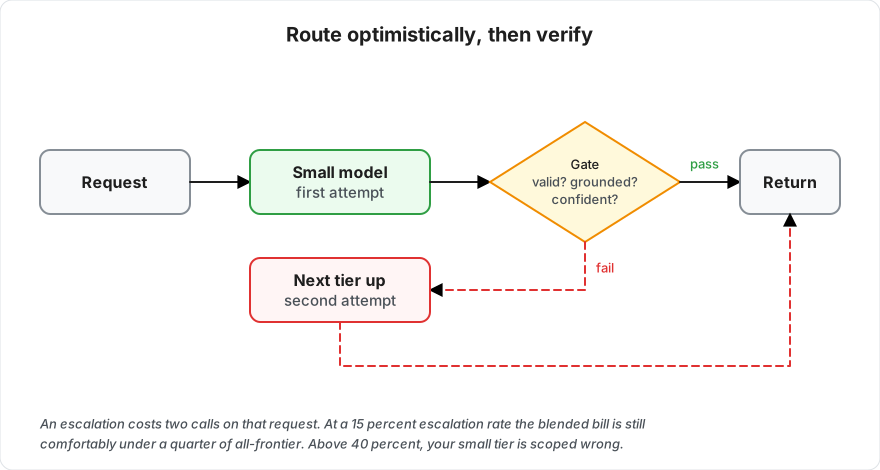
Note the direction of the loop. A failed attempt escalates one tier and returns; it does not bounce back to the router to be re-scored. Re-scoring gives you a path to an infinite loop on a request the router keeps classifying the same way, and I’ve seen exactly that burn a weekend of budget on a handful of malformed inputs.
Design the checks so they’re cheap. Schema validation and a downstream sanity check cost you nothing. A grounding check on every response is not free, so sample it rather than running it inline on all traffic once you trust the tier.
Does self-hosting help?
It comes up in every one of these conversations, so let’s deal with it.
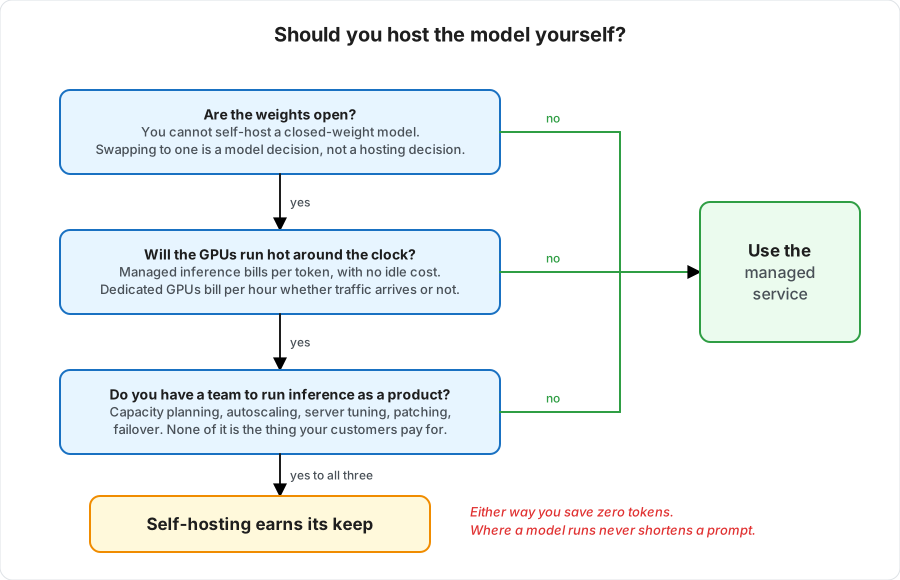
Self-hosting saves you exactly zero tokens. Token count is a property of the model and your prompts, not of where the weights happen to sit. Running Llama on your own GPUs does not shorten a prompt. Drop “save tokens” from the self-hosting case entirely, because caching, routing, and prompt compression are identical either way.
On cost, it depends entirely on utilisation. Managed inference bills per token with no idle cost. Dedicated GPUs bill per hour whether traffic arrives or not, and frontier-class open models need expensive multi-accelerator instances to serve at all. If your GPUs run above roughly 70 to 80 percent busy around the clock, self-hosting can beat per-token pricing. Most enterprise traffic is spiky and business-hours shaped, which means you’d be paying for idle silicon. Provisioned or reserved throughput from your platform captures much of the steady-high-volume discount without you owning any infrastructure.
There’s also a category error hiding in the question. The flagship closed models have no self-hosting option at all, so “let’s self-host to cut our Claude bill” is not a hosting decision, it’s a decision to use a different model. Self-hosting means open weights: Llama, Mistral, Qwen, DeepSeek, and the open-weight releases from the big labs. That may well be the right call, but evaluate it as a model swap, with a quality bar, not as an infrastructure optimisation.
Governance is the genuine argument, and it’s a good one. The weights are physically yours, they don’t change under you when a vendor deprecates a version, the data never crosses your boundary, and you can instrument the model internals. For the strictest data sovereignty and reproducibility requirements, that’s decisive. But be honest about the increment: managed platforms already offer in-region processing, private network paths, contractual commitments that your data isn’t used for training, and built-in guardrails. The remaining gain is narrower than most people assume, and it’s usually “the weights never leave our walls.”
Then there’s the cost nobody puts in the spreadsheet. Self-hosting means you own capacity planning, autoscaling, model server tuning, patching, failover, and the team that does all of it. That line item routinely dwarfs the GPU-hour versus token comparison that motivated the exercise.
My default: use the managed service. Self-host only when you have a hard requirement that in-region managed inference genuinely cannot satisfy, or sustained near-continuous high utilisation on an open-weight model, and you have the platform capability to run inference as a first-class product. For most teams, routing and caching on a managed platform gets you the large majority of the value without hiring a GPU operations team.
Where this goes wrong
The router costs more than it saves. If your complexity classifier is itself an LLM call on every request, you’ve added a tax to 100 percent of traffic to save money on 75 percent of it. Keep the router to rules, an embedding lookup, or a managed endpoint.
Nobody watches the escalation rate. This is your single most important metric and it’s the one I most often find unmonitored. Below 15 percent, your small tier is well scoped. Above 40 percent you’re paying twice for a large fraction of traffic and you should move those request types up a tier permanently.
Caching and routing fight each other. Prompt caches are per model. If a similar request bounces between two models, you halve your hit rate on both. Route first, then cache within the tier, and don’t route on anything that varies request to request when the prefix is otherwise identical.
Quality regression is silent. Nothing pages you when the small tier gets 4 percent worse at an extraction task after a prompt change. Log a sample of small-tier outputs and re-run the measurement against your fixed test set on a schedule. Every platform has an evaluation service now, and it doesn’t matter which you use as long as something is comparing tiers on the same inputs over time.
Batch traffic shouldn’t touch the router at all. If it’s asynchronous and tolerates a delay, send it to the batch endpoint at roughly half price and skip the tiering entirely. Routing is a real-time optimisation. I’ve seen a team run their nightly backfill through a latency-optimised routing path and pay double for work nobody was waiting on.
The short version
It’s arithmetic. Small models are 10 to 60 times cheaper per token, so if you can safely send the routine 80 percent of your work to one and verify the answer before trusting it, your blended cost drops by roughly 80 percent while the hard cases still get the expensive model. The routing isn’t the hard part. Working out which tier each task type belongs in, and writing the check that makes aggressive routing safe, those are the hard parts, and they’re worth your best engineer.
References
-
Anthropic, ‘Define success criteria and build evaluations’, Claude Platform Docs.
-
H. Husain, ‘Your AI Product Needs Evals’, Hamel’s Blog.
-
OpenAI, ‘Evaluating model performance’, OpenAI Platform Documentation.
-
I. Ong et al., ‘RouteLLM: Learning to Route LLMs with Preference Data’, arXiv:2406.18665.
-
Amazon Web Services, ‘Understanding intelligent prompt routing in Amazon Bedrock’, Amazon Bedrock User Guide.
-
Anthropic, ‘Prompt caching’, Claude Platform Docs.
-
Google Cloud, ‘Context caching overview’, Vertex AI Generative AI Documentation.
-
G. Hinton, O. Vinyals and J. Dean, ‘Distilling the Knowledge in a Neural Network’, arXiv:1503.02531.
-
N. Shazeer et al., ‘Outrageously Large Neural Networks: The Sparsely-Gated Mixture-of-Experts Layer’, arXiv:1701.06538.